

How connectivity is rewriting the rules of travel safety
A nine-market study on what impacts travelers’ sense of safety — and how differently it plays out based on where you’re from.
In this report:
- Global Findings
- Country-Level Findings
- Key Takeaways: How to Stay Safe When Traveling
- 2027 Travel Predictions
GLOBAL FINDINGS
Travel fears are universal. Mostly.
Not very long ago, feeling safe while traveling meant clutching a dog-eared guidebook, sticking exclusively to well-lit areas, and never straying too far from your tour group. Ask travelers today what actually makes them feel safe, and the answer is far simpler: a mobile connection.
That's the clearest signal in a new study Airalo commissioned with YouGov, which surveyed 4,527 international travelers across nine countries. The results revealed that connectivity has quietly become the go-to safety tool for travelers around the globe. However, the importance of connectivity depends heavily on where you’re from and who you are.
Key global findings:
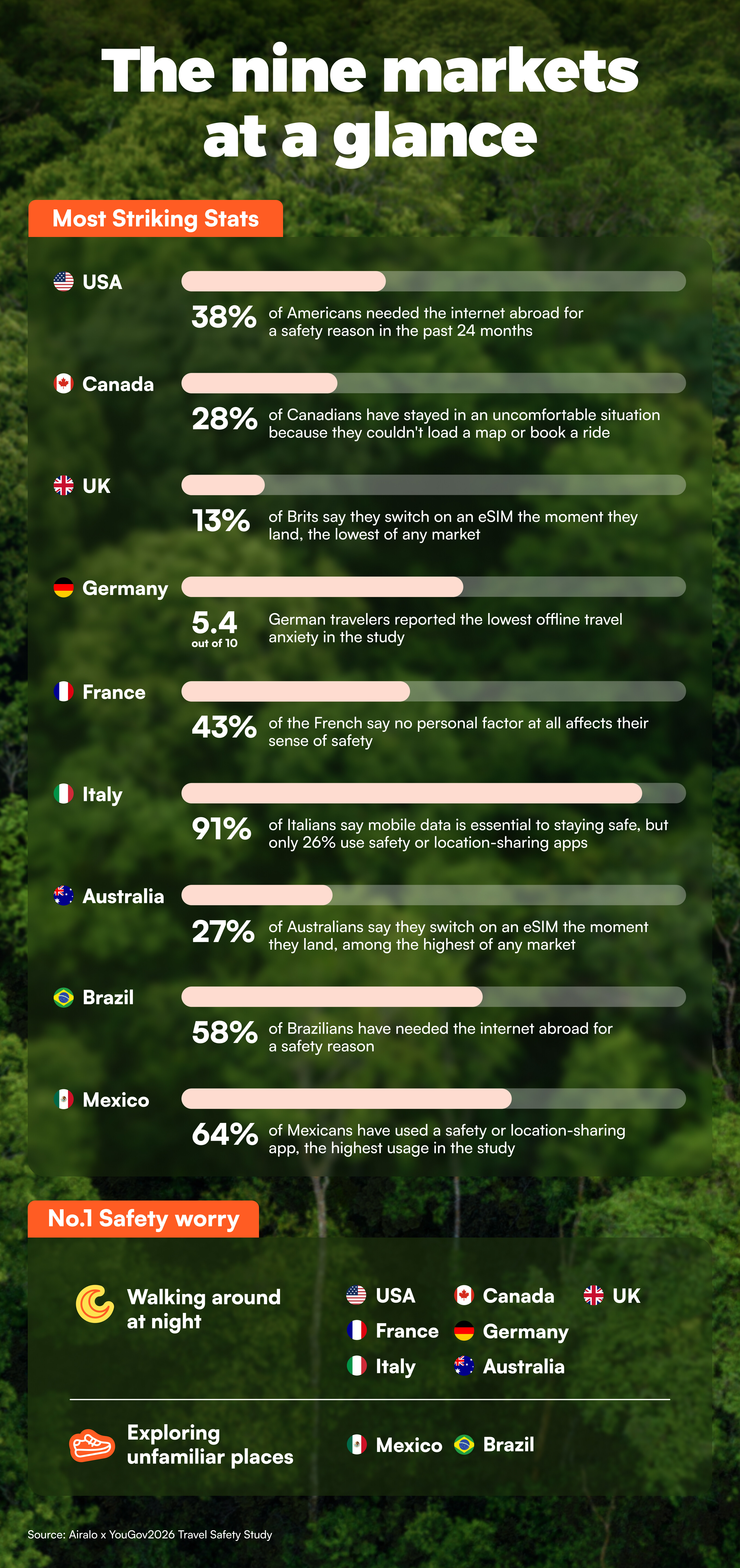
- Travel safety worries are overwhelmingly situational. In all but two countries (Brazil and Mexico), walking around at night is what rattles travelers the most, with 50% identifying it as their top travel-related anxiety, followed by exploring unfamiliar areas (38%), and going out at night (e.g., clubbing, dancing – 31%).
- Being a woman or LGBTQIA+ amplifies travel anxiety in every situation. While traveling alone is the strongest personal factor globally at 28%, the gap widens sharply for women (57% worry about walking at night, versus 50% overall) and for LGBTQIA+ travelers, who report higher anxiety on nearly every scenario measured.
- Most travelers are reactive, not proactive. Saving emergency numbers and embassy details before departure remains uncommon (unless you’re from Brazil, the most-prepared market), so confidence gets built in the moment, usually through a phone and a strong internet connection.
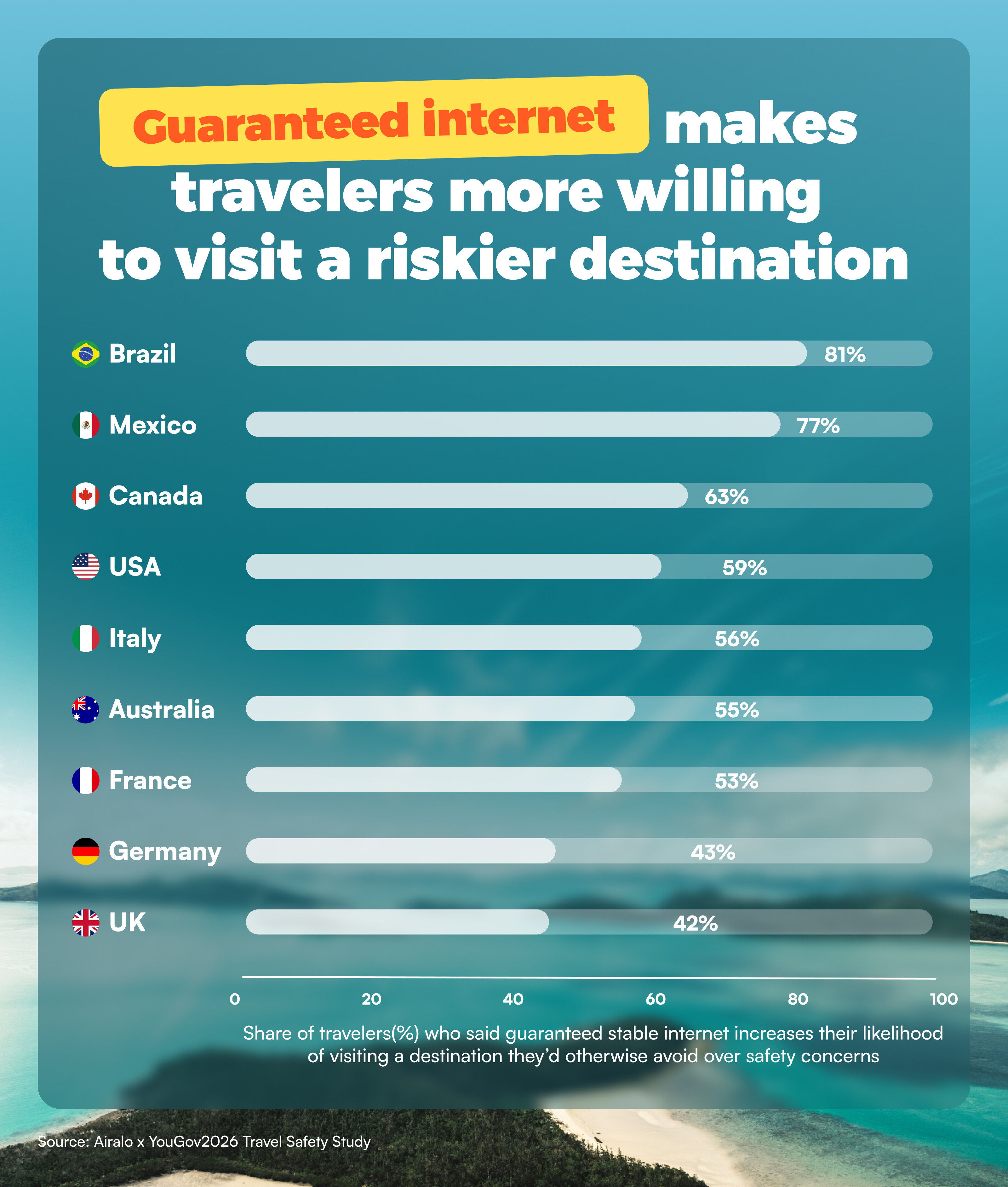
- Having connectivity doesn't just calm nerves, it expands the map. 57% of travelers say a guaranteed stable internet connection makes them more likely to visit a destination they'd otherwise avoid over safety concerns. Even more, 77% agree a stable connection gives them a better sense of freedom to explore off the tourist trail.
Having global connectivity isn't just about feeling calmer, but about empowering travelers to decide exactly where and how far they want to explore.
COUNTRY-LEVEL FINDINGS
NORTH AMERICA
UNITED STATES
High-anxiety travelers worried about communication barriers
For American travelers, heading overseas is a big leap. Because the US is so massive and spread out, going abroad usually means logging longer flight hours, navigating brand-new languages, and stepping much further out of your comfort zone than, say, a European traveler hopping across a nearby border.
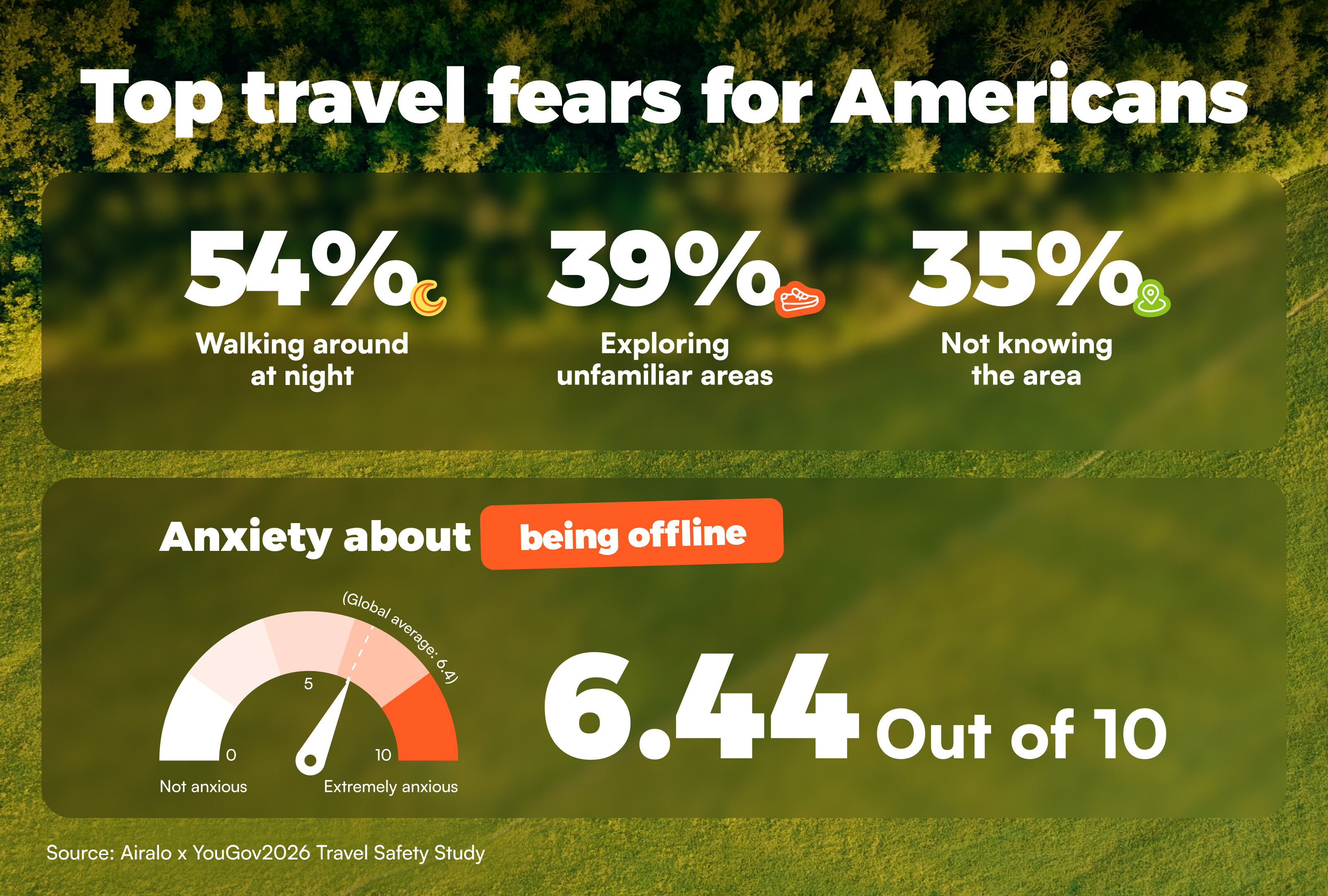
It can be a huge departure from daily life — and that difference really shows in the data. Because international travel feels like such a big jump into the unknown, Americans often feel more vulnerable about their personal safety abroad, whether that comes down to their age, gender, race, or background. Interestingly, 17% of Americans say their country of origin affects how safe they feel abroad, well above the relatively low 10% global average, making the US one of the more pronounced outliers in the study.
WHAT SETS THE US APART
Since many Americans speak just one language, it’s no surprise that the language barrier is a top concern when heading overseas. In fact, 33% of US travelers polled say that being able to chat with locals directly impacts how safe they feel — making communication a much bigger priority for Americans than for travelers from almost any other market.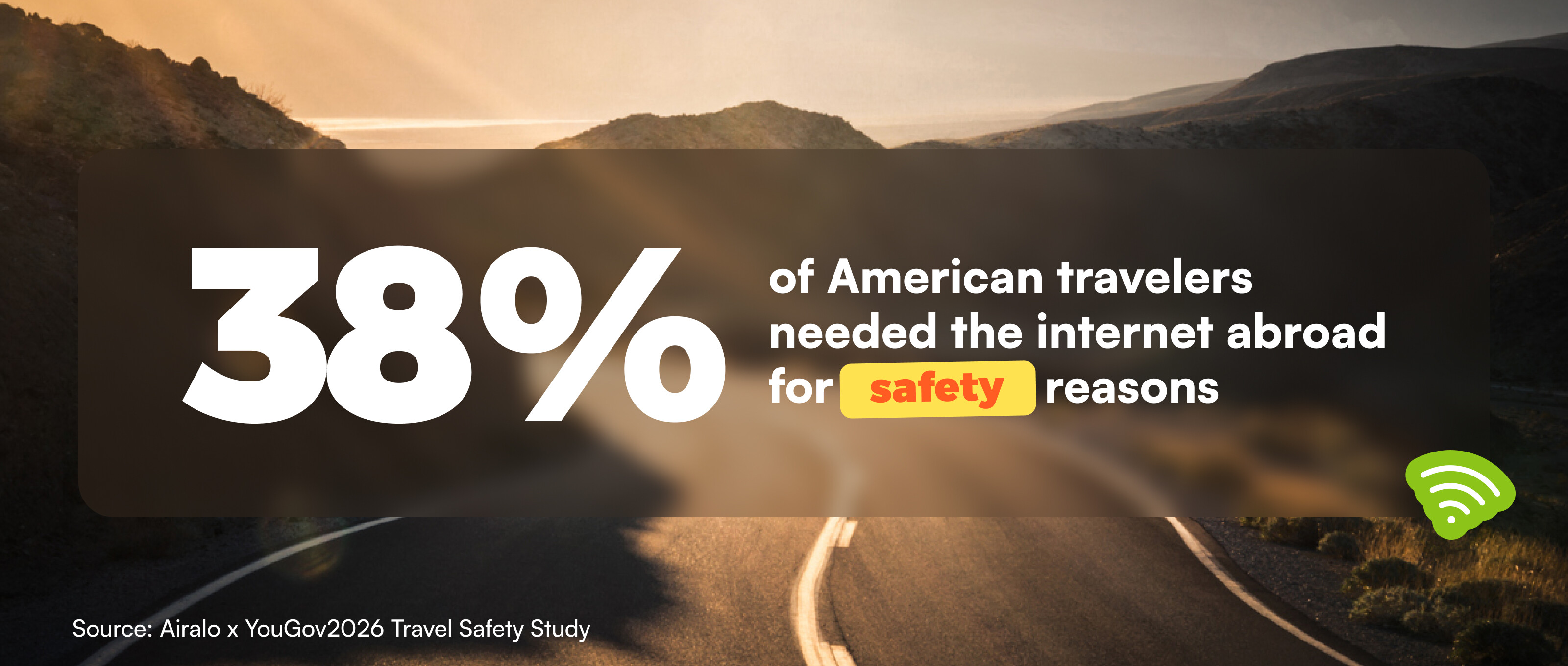
THE AMERICAN IDENTITY GAP
For many American travelers (42%), personal identity doesn't really affect how safe they feel on the road — they’re more focused on the situation at hand. But for those who do feel a bit more vulnerable as a result of their identity, three main factors stand out: traveling solo (30%), gender (19%), and their country of origin (17%).
We also know that safety isn't a one-size-fits-all feeling. While US travelers tend to be more cautious in general, women and LGBTQIA+ explorers often carry a heavier mental load while navigating the globe:
- 38% of American women worry about traveling alone (compared to 30% overall)
- 32% of American women cite their gender as a safety factor (compared to 19% overall)
- 39% of American LGBTQIA+ travelers say their sexuality affects their sense of security (compared to just 7% overall)
- 38% of American LGBTQIA+ travelers stress about where they’re staying (compared to 24% overall)
HOW AMERICAN TRAVELERS RELY ON CONNECTION
When you're far from home, a solid internet connection is your best travel buddy. It’s the ultimate safety net for US travelers, who rely on their data to navigate the unknown with confidence. Here’s how they’re using it:
- 57% rely on maps and travel apps to find their way around
- 52% share their location to keep friends and family back home in the loop
- 52% lean on translation apps to bridge the language gap and ease communication stress
CANADA
Cautious explorers who value preparedness
Canada is massive, but the vast majority of its population lives just a short drive from its only land neighbor: the US. For most Canadians, genuinely "going abroad" means crossing an ocean and leaving the continent altogether. Because this is a much bigger leap than the short border hops European travelers make, Canadians tend to be highly cautious. In fact, Canadians report the highest level of concern regarding nighttime safety out of all the countries surveyed. It’s a big reason why having reliable mobile data the moment they land is such a priority.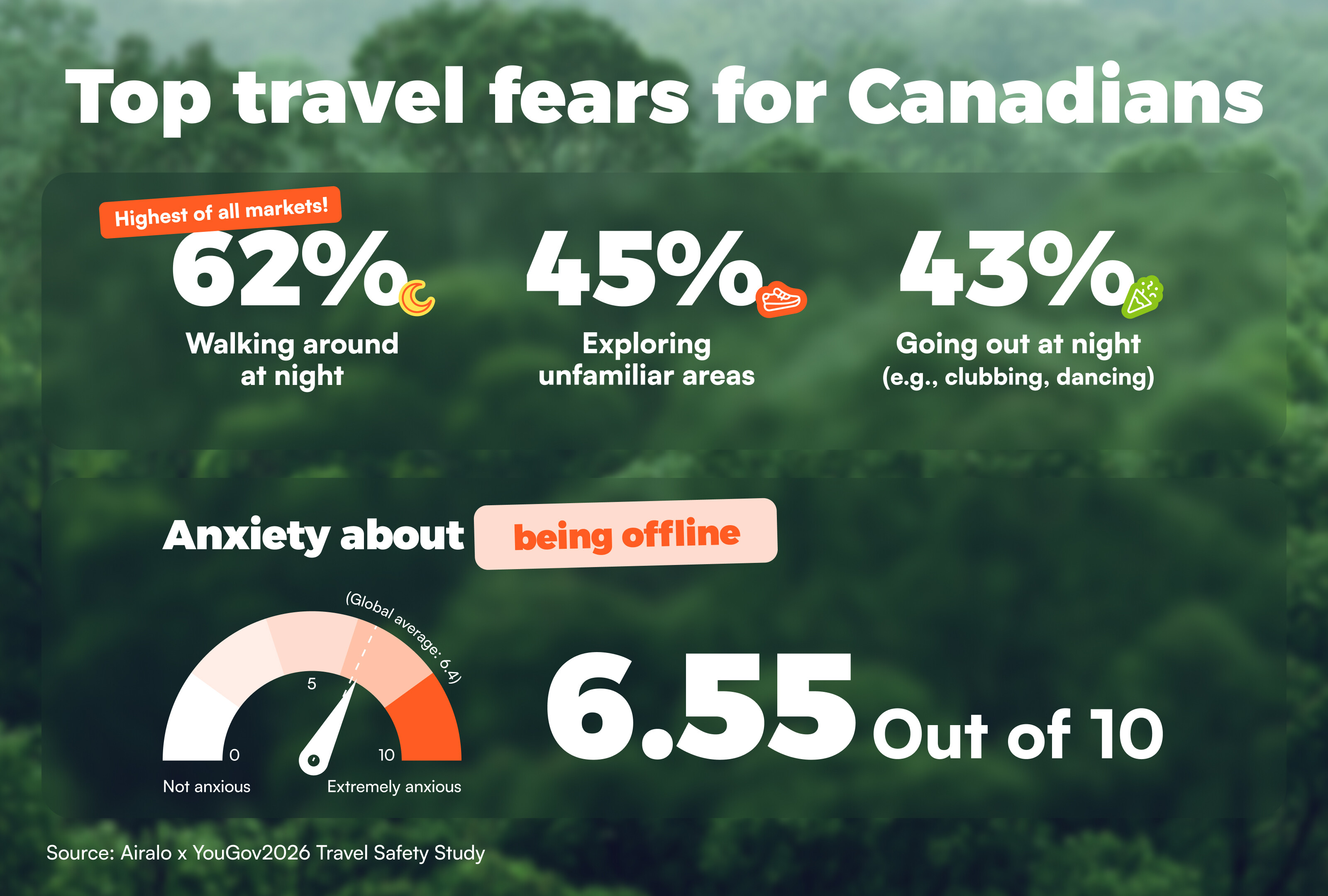 WHAT SETS CANADA APART
When it comes to travel, Canadians are highly mindful of their surroundings. Only 10% say that no situation makes them feel unsafe. That means a sweeping 90% of Canadian travelers have at least one specific safety trigger they keep an eye out for while navigating a new destination.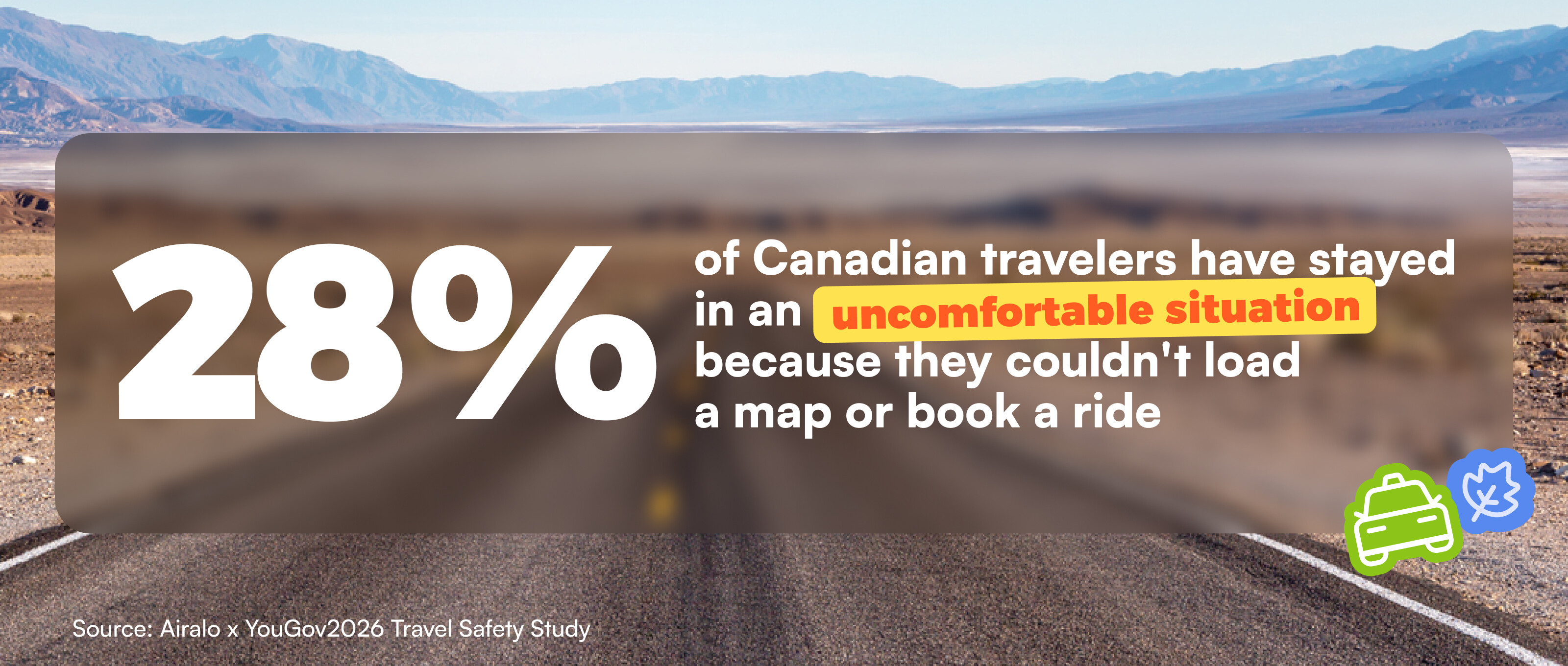 THE CANADIAN IDENTITY GAP
For Canadians who are already mindful about traveling solo or about their gender, their baseline fears are turned up a notch. For instance, the concern about walking around at night jumps from 62% nationally to 74% for solo travelers, and all the way to 78% for those who cite their gender as a safety factor.
These patterns continue to show up along personal identity and sexuality lines, with women and LGBTQIA+ Canadians carrying a heavier mental load:
- 71% of Canadian women worry about walking at night (compared to 62% overall)
- 42% of Canadian women say traveling alone affects their safety (compared to 30% overall)
- LGBTQIA+ Canadians report the highest "offline anxiety" of any group, rating their stress without internet access at a 7.3 out of 10 (compared to 6.6 overall)
- 39% of LGBTQIA+ Canadians cite their sexuality as a negative safety factor (compared to just 10% overall)
HOW CANADIAN TRAVELERS RELY ON CONNECTION
Because Canadians are so thoughtful about their safety, seamless connectivity is their ultimate travel tool. Here’s how they rely on their mobile data to stay secure and confident abroad:
- 58% rely on maps and travel apps to navigate unfamiliar streets
- 57% update friends and family back home with their current location
- 45% use translation apps to bridge the language gap and feel more at ease
EUROPE
THE UNITED KINGDOM
Frequent flyers with a sharp focus on gender identity
With mainland Europe right on the UK's doorstep, hopping over to Paris or Amsterdam for a quick weekend getaway is incredibly common for British travelers. Because international travel is a frequent, casual habit rather than a massive leap into the unknown, UK travelers report some of the lowest "offline anxiety" out of all the countries surveyed.
UK travelers are also less likely to connect their eSIM immediately upon arrival, but this comes down to old habits and travel confidence. For years, short-haul European trips meant seamless, pre-Brexit roaming, leading many travelers to assume they can still rely on their home SIMs today. Between that lingering habit and the comfort of visiting familiar neighboring countries, British travelers naturally take a more relaxed, "we'll get to it when we get to it" approach to setting up their data.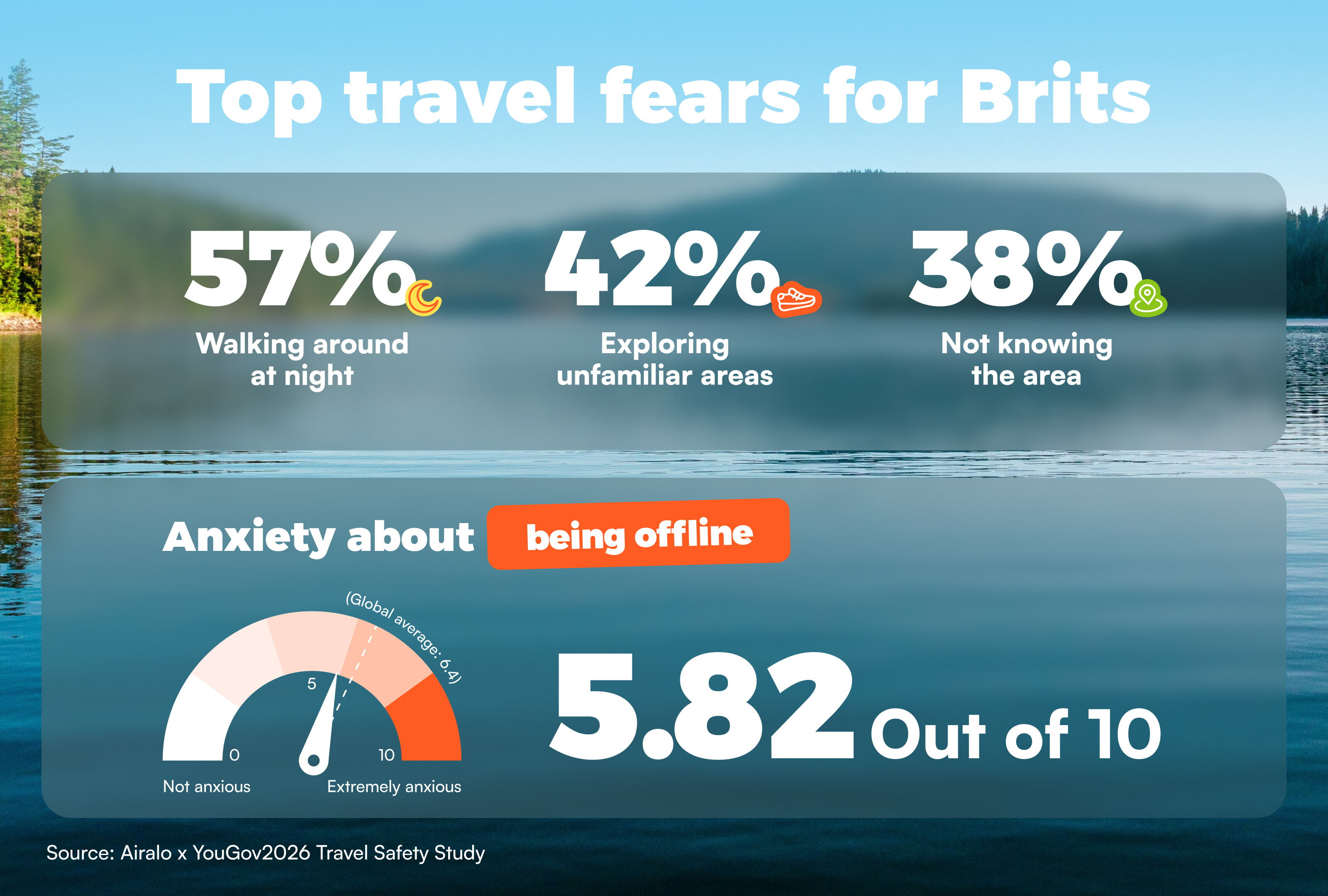 WHAT SETS THE UK APART
When it comes to assessing safety, gender takes center stage for UK travelers. In fact, 27% cite their gender as a primary factor affecting their personal safety abroad — the highest rate anywhere in Europe. For British women, that number nearly doubles to 51%. Combine this with the fact that 70% of women worry about walking around at night and 41% are concerned about traveling solo, and it becomes clear that gender isn't just a minor detail in the UK data.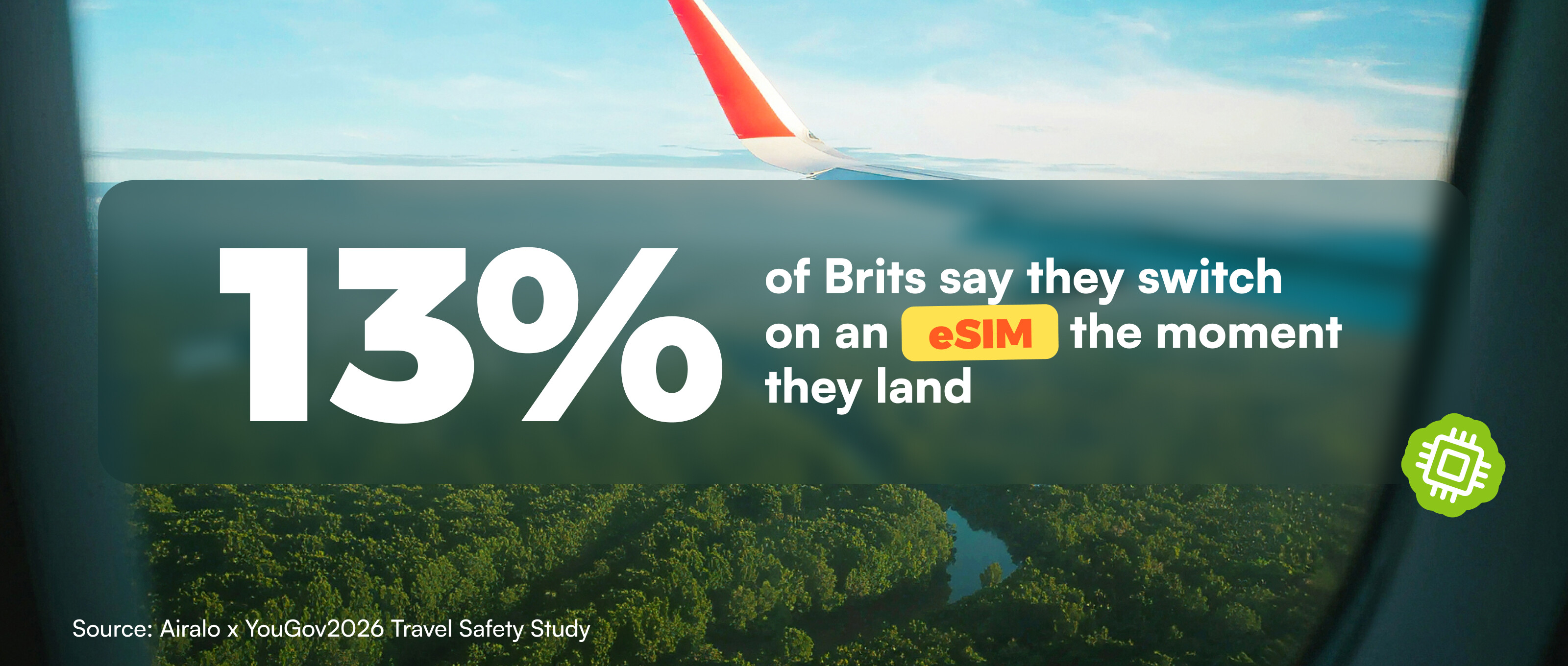 THE BRITISH IDENTITY GAP
These concerns sharpen even further for women and LGBTQIA+ travelers, who experience the world quite differently than the national average:
- 51% of British women cite gender as a safety factor (compared to 27% overall)
- 70% of British women worry about walking at night (compared to 57% overall)
- 42% of British LGBTQIA+ travelers cite their sexuality as a safety factor (compared to just 6% overall)
- 78% of British LGBTQIA+ travelers are familiar with travel safety apps (compared to 59% overall), making them the most well-prepared group in the market
HOW BRITISH TRAVELERS RELY ON CONNECTION
Even with their high travel confidence, Brits know that a seamless connection makes every trip smoother. Here’s exactly how they lean on their mobile data to stay secure and stress-free abroad:
- 59% rely on maps and travel apps to confidently find their way around new destinations
- 49% check in with loved ones back home to share their location and provide peace of mind
- 41% use translation apps to effortlessly bridge the language gap
GERMANY
Europe's calmest travelers
Sitting right at the crossroads of Europe, Germany shares borders with nine different countries. For many Germans, hopping on a quick train and crossing an international border feels more like a standard routine than a grand adventure. Because international travel is so deeply woven into everyday life, German travelers report the lowest "offline anxiety" of any market in our study. In fact, they’re among the least likely to let the promise of guaranteed internet sway their decision to visit a riskier destination.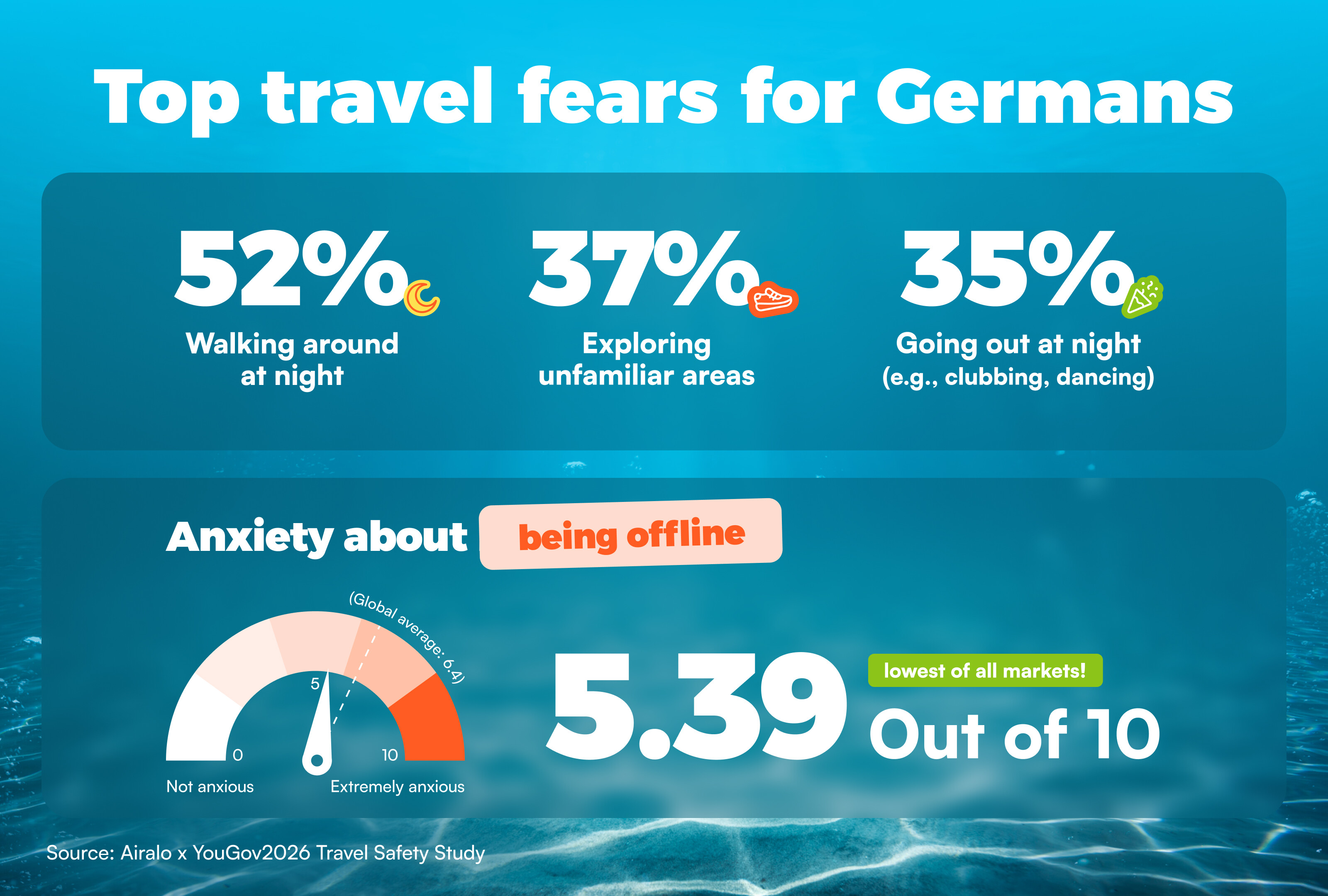 WHAT SETS GERMANY APART
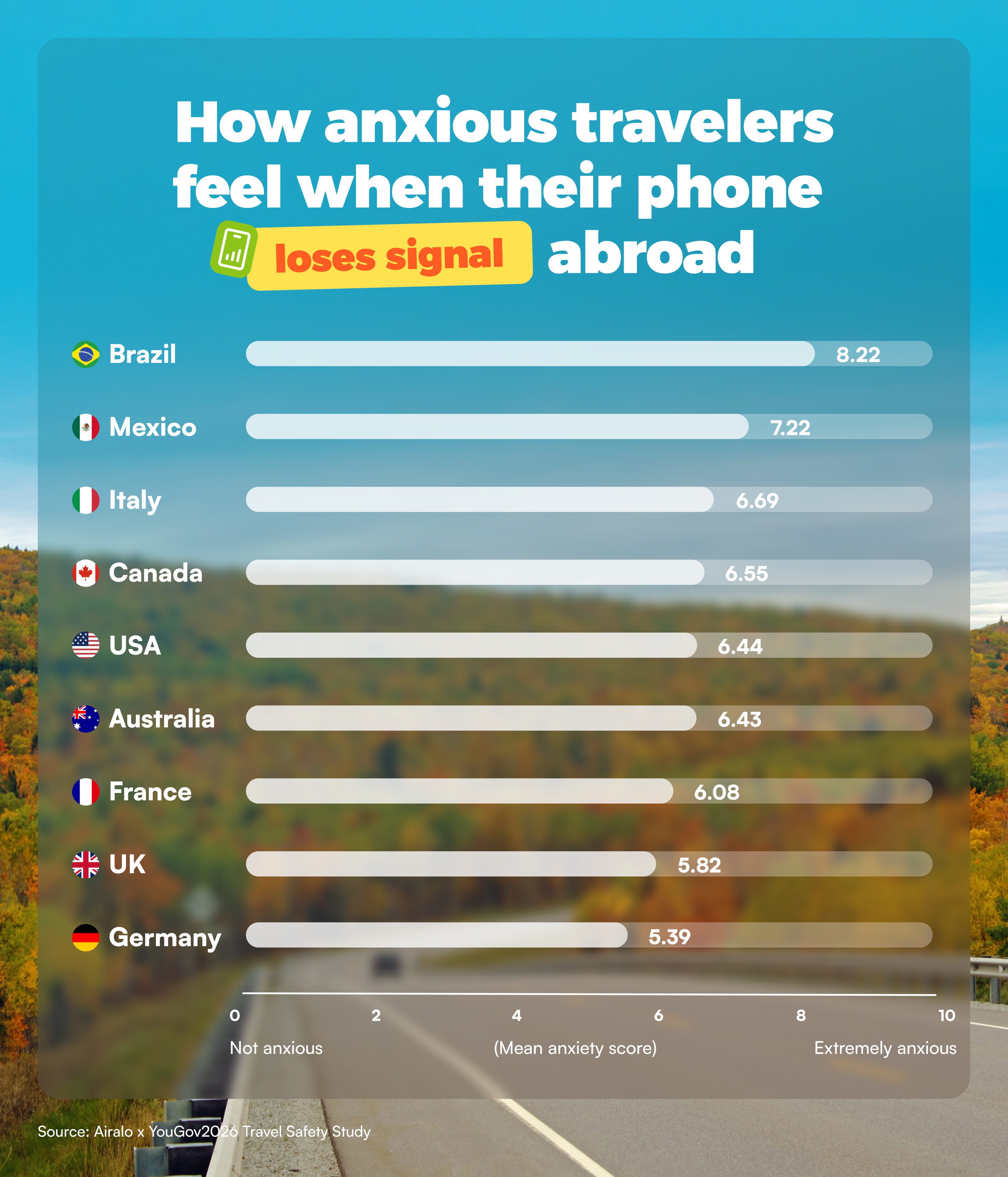
Losing mobile signal barely fazes the average German traveler. Their offline anxiety sits at a calm 5.39 out of 10 — the lowest of any market surveyed. Only 43% say that guaranteed internet would make them more willing to visit a riskier destination. For most Germans, staying connected is certainly a helpful convenience, but it rarely feels like an absolute lifeline.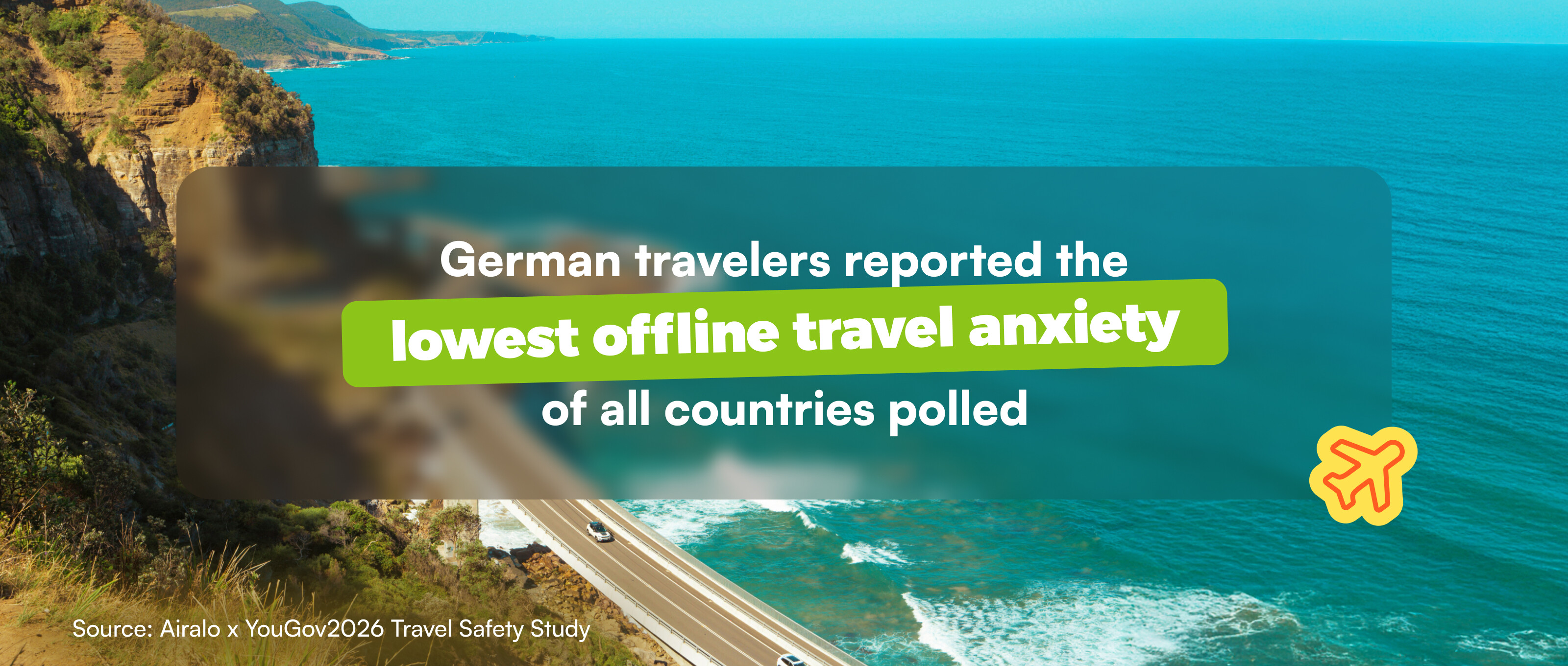 THE GERMAN IDENTITY GAP
For the majority of German travelers, the specific situation they’re in matters far more than their personal identity when assessing safety. For those who do feel a bit more vulnerable, the top concerns are traveling solo (25%), their gender (16%), and their age (10%) — which are noticeably lower thresholds than in most other markets.
However, this overarching national calm doesn’t apply to everyone. Women and LGBTQIA+ explorers in Germany carry a heavier mental load and experience travel quite differently from the national average:
- 57% of German women worry about walking at night (compared to 52% overall)
- 84% of German women consider mobile data essential to their safety (a full nine points above the national average of 75%)
- German LGBTQIA+ travelers report the highest "offline anxiety" of any group in the market, rating their stress at a 6.0 out of 10 (compared to 5.39 nationally)
- 35% of German LGBTQIA+ travelers cite their sexuality as a safety factor (compared to just 5% overall)
HOW GERMAN TRAVELERS RELY ON CONNECTION
Even for the calmest travelers in Europe, a solid data connection helps smooth out the journey and provides peace of mind when it counts. When German travelers do tap into their mobile data, here’s exactly what they’re using it for:
- 53% rely on maps and travel apps to seamlessly navigate new surroundings
- 46% use translation apps to effortlessly bridge language gaps and connect with locals
- 33% check in with loved ones back home to share their location and provide a quick update
FRANCE
Confident explorers with a more relaxed approach
Located in the heart of Europe and one of the most visited countries in the world, France is accustomed to cross-border travel and a constant stream of international visitors. This deep familiarity with global mobility likely explains why French travelers report among the highest levels of personal confidence in our study. In fact, 43% say that no personal factor at all makes them feel less safe abroad. However, this confidence tends to show up as staying calm in the moment rather than as extensive preparation ahead of time.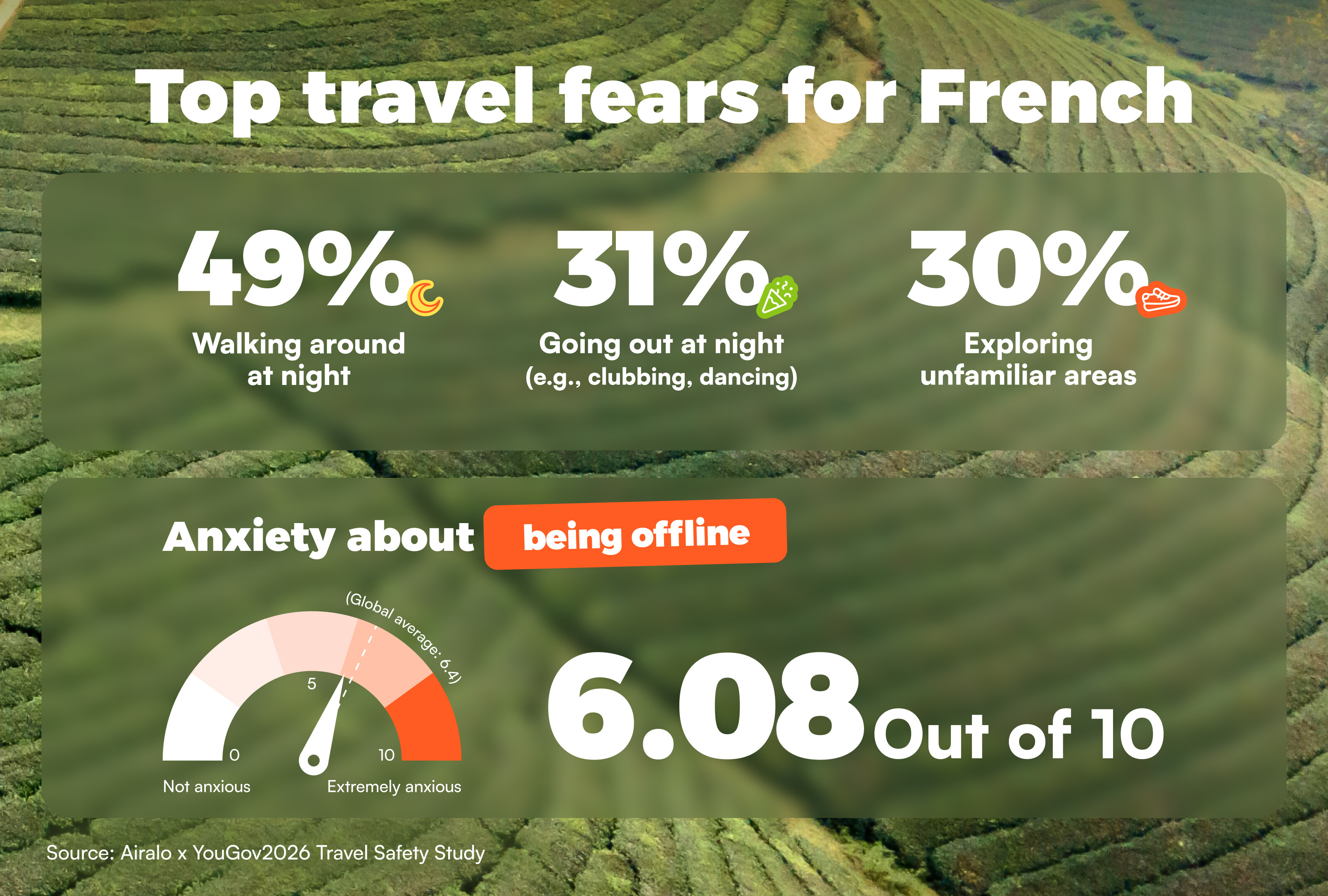 WHAT SETS FRANCE APART
With 43% stating that no aspect of their identity makes them feel less secure, France boasts one of the highest traveler confidence levels in the study (after Germany and Italy). For the French travelers who do feel a bit more exposed because of who they are, their top concerns are traveling solo (30%), their gender (14%), and their age (11%) are the primary concerns.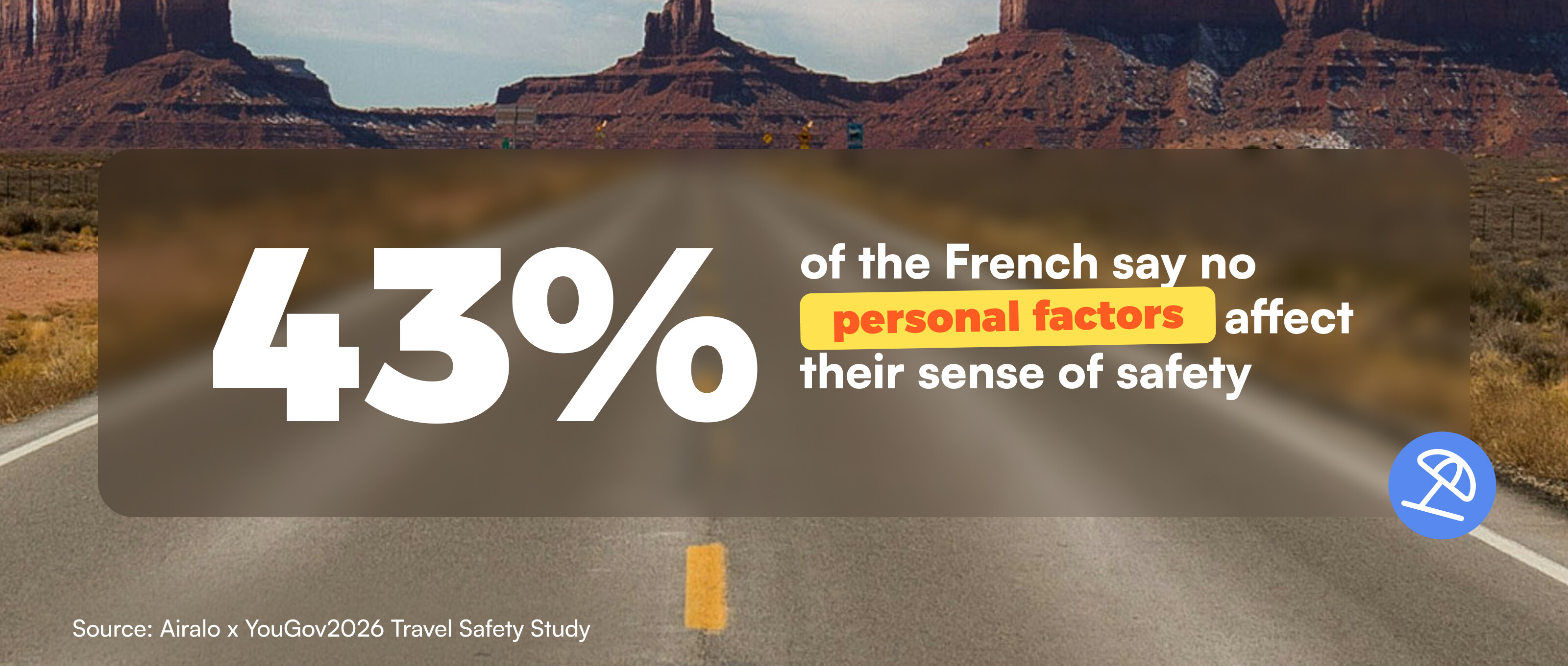 THE FRENCH IDENTITY GAP
Just because they’re naturally confident doesn’t mean French travelers throw caution to the wind once they cross a border. Solo travelers still routinely reach for their phones to stay aware of their surroundings. Interestingly, while 59% of French travelers know that dedicated travel safety apps exist, only 36% have actually used one — making it one of the widest gaps between awareness and action in the study!
As we see in other markets, this overarching national confidence narrows sharply for women and LGBTQIA+ travelers, who report meaningfully higher concerns than the average:
- 41% of French women worry about traveling alone (compared to 30% overall)
- 59% of French women worry about walking at night (compared to 49% overall)
- 87% of French women consider mobile data absolutely essential to their safety (compared to 78% overall)
- 27% of French LGBTQIA+ travelers cite their sexuality as a safety factor (roughly four and a half times the national average of just 6%)
HOW FRENCH TRAVELERS RELY ON CONNECTION
Even the most confident and reactive travelers need a reliable safety net when navigating new places. When French explorers tap into their mobile data on the go, here’s how they use it:
- 50% rely on maps and travel apps to confidently find their way around
- 45% use translation apps to ease communication and connect with locals
- 42% check the safety levels of their surrounding areas on the fly
ITALY
Dedicated to staying connected, but skipping the travel prep
Italy isn't just one of the most visited countries in the world; Italians themselves are avid explorers. Thanks to open borders and an incredible network of low-cost flights and trains, crossing into a neighboring European country feels like an everyday occurrence. This constant movement likely explains why Italian travelers believe in the power of connectivity more than anyone else surveyed: a staggering 91% call mobile data absolutely essential to their safety abroad (the highest share in the entire study). However, this strong belief doesn’t always translate into active preparation.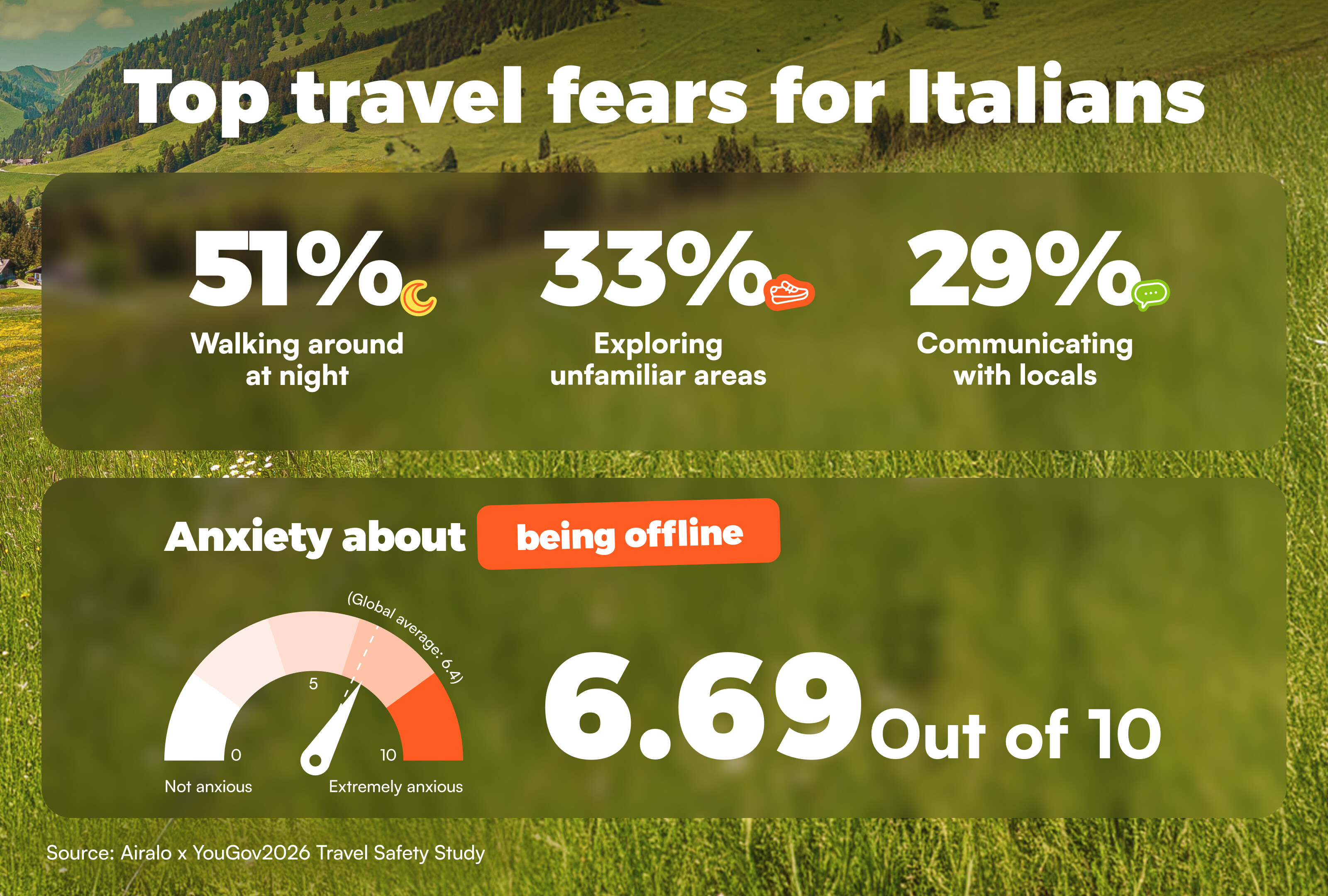 WHAT SETS ITALY APART
While a massive 91% of Italians agree that having a mobile connection is crucial for staying safe, they take a surprisingly relaxed approach to specialized travel tools. Only 46% are even aware that dedicated travel safety apps exist, and a mere 26% have ever actually used one — both the lowest figures we saw anywhere in the study. Essentially, Italians hold the strongest belief in the value of staying connected, yet they’re the least likely to use the specialized safety apps built around it.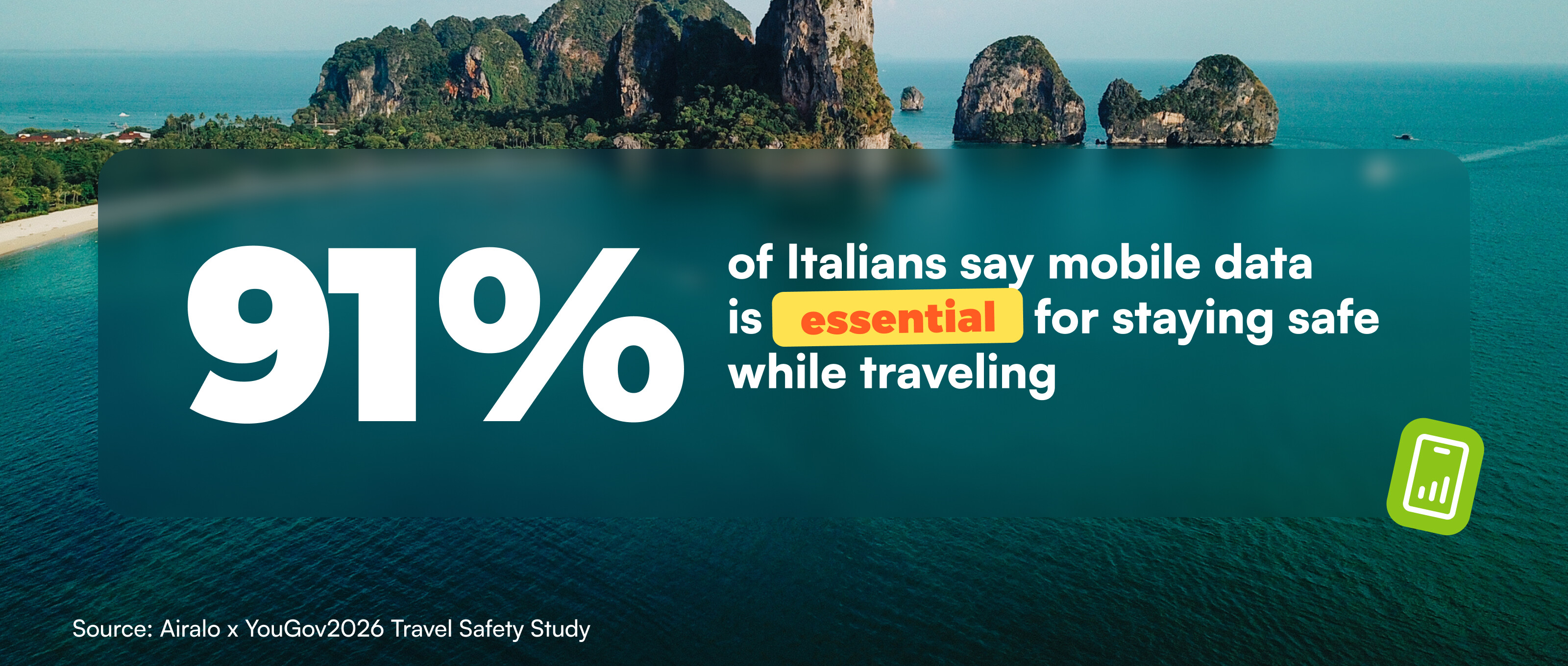 THE ITALIAN IDENTITY GAP
When it comes to personal identity, Italian travelers are generally quite relaxed, letting the situation dictate their comfort level rather than who they are. In fact, 54% say that no personal factor at all makes them feel less secure while traveling—the highest baseline of confidence out of any market surveyed. For the minority who do feel a bit more exposed, traveling alone (23%) and their gender (11%) are the primary concerns.
However, women and LGBTQIA+ travelers experience things a bit differently, breaking away from this overarching national confidence:
- 62% of Italian women worry about walking at night (compared to 51% overall)
- 30% of Italian women cite traveling alone as a safety factor (compared to 23% overall)
- 22% of Italian LGBTQIA+ travelers cite their sexuality as a safety factor (eleven times the national average of just 2%)
- Interestingly, Italian LGBTQIA+ travelers are actually less willing to visit a riskier destination even if guaranteed internet is provided (49% compared to the national average of 56%) — a unique reversal of the pattern we see almost everywhere else in the study
HOW ITALIAN TRAVELERS RELY ON CONNECTION
While they might skip the dedicated safety apps, Italian travelers still know that a solid connection is their best friend on the road. When solo travelers tap into their data, here are their top habits for navigating new destinations with ease:
- 58% rely on maps and travel apps to seamlessly find their way around
- 42% use translation apps to bridge language gaps and connect with locals
OCEANIA
AUSTRALIA
Deliberate travel planners who value connection
Because of Australia's geographic isolation, heading overseas is rarely a quick or spontaneous decision. With some of the longest international flight times in the world, trips abroad tend to be highly deliberate and well-planned. This might explain why Australian travelers skew significantly older than every other market surveyed (52% are 55 or older), often embarking on these major journeys a bit later in life. Yet, all that extra life experience doesn’t entirely erase travel jitters. When they lose signal, Australians report a very relatable "offline anxiety" score of 6.43 out of 10 — almost identical to much younger US travelers.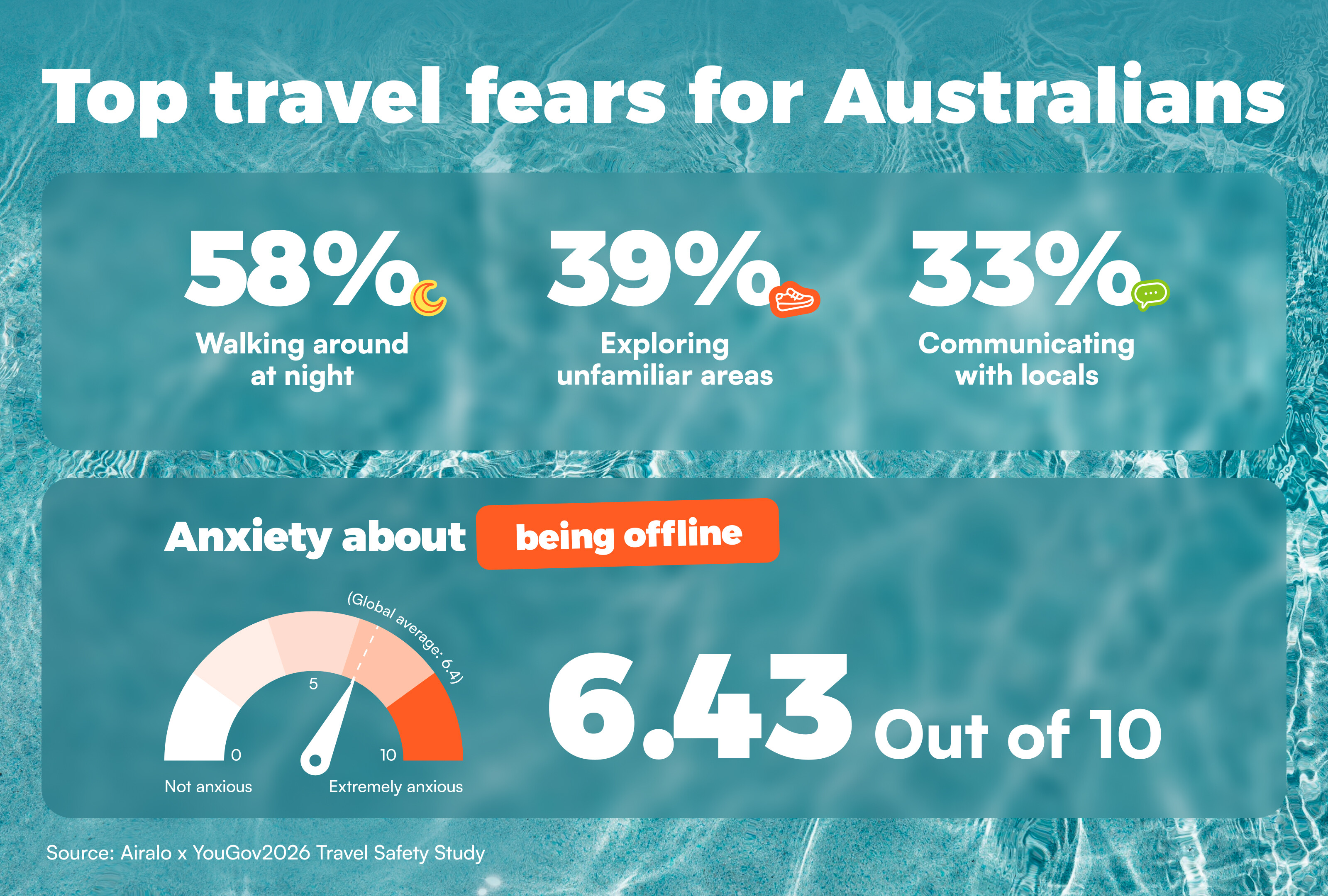 WHAT SETS AUSTRALIA APART
Despite being the oldest demographic in our study, Australian travelers sit squarely in the middle of the pack when it comes to offline anxiety. Age alone doesn’t seem to drive their stress levels. Instead, they’re highly proactive about staying online: a remarkable 27% of Australian travelers switch on an eSIM the moment they land, making them one of the most tech-ready markets for seamless connectivity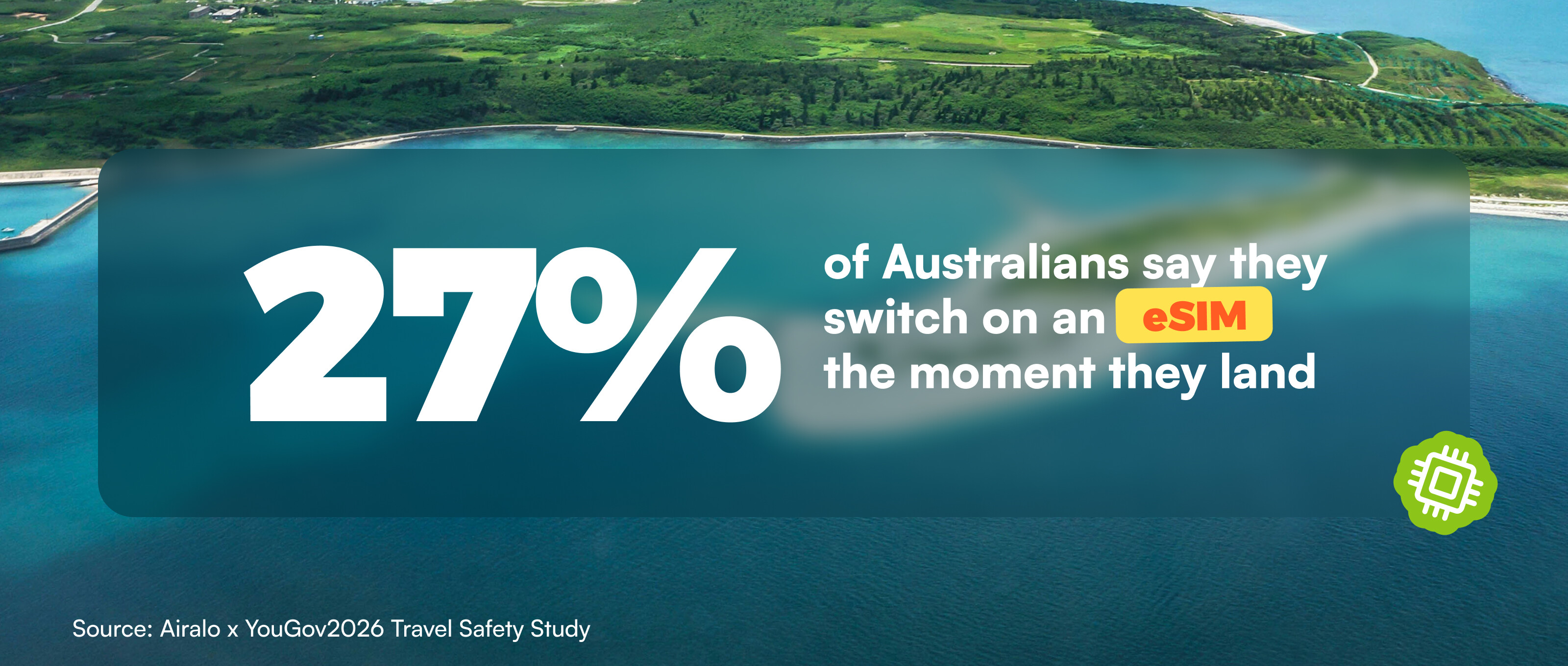 THE AUSTRALIAN IDENTITY GAP
For most Australians (42%), personal identity takes a backseat to the specific situation they’re in when assessing safety. For the remaining travelers who do feel a bit more exposed, their top concerns are traveling solo (30%), their age (20%), and their gender (16%).
However, the travel experience shifts sharply for women and LGBTQIA+ travelers, who navigate the globe with different considerations in mind:
- 31% of Australian women say their choice of destination significantly affects their sense of safety (compared to 27% overall)
- 40% of Australian women worry about traveling alone (compared to 30% overall)
- 48% of Australian LGBTQIA+ travelers worry about traveling alone (the highest rate of any group in the market, compared to 30% overall)
- 37% of Australian LGBTQIA+ travelers cite their sexuality as a safety factor (compared to just 4% overall)
HOW AUSTRALIAN TRAVELERS RELY ON CONNECTION
Since they usually travel very far from home, Australians know exactly how to put their mobile data to good use. Here’s how they stay connected and confident on the road:
- 61% rely on maps and travel apps to seamlessly find their way around
- 57% check in with loved ones back home to share their location
- 49% lean on translation apps to easily navigate unfamiliar languages
LATIN AMERICA
BRAZIL
Highly anxious, but also highly prepared
Brazilian travelers bring a uniquely well-developed tech habit with them wherever they roam. Because they often integrate safety tools into their daily routines back home, they’re the most tech-prepared group in our study. An impressive 84% are aware of dedicated travel safety apps, and 60% actively use them — meaning they have built a digital safety net long before they ever pack their bags.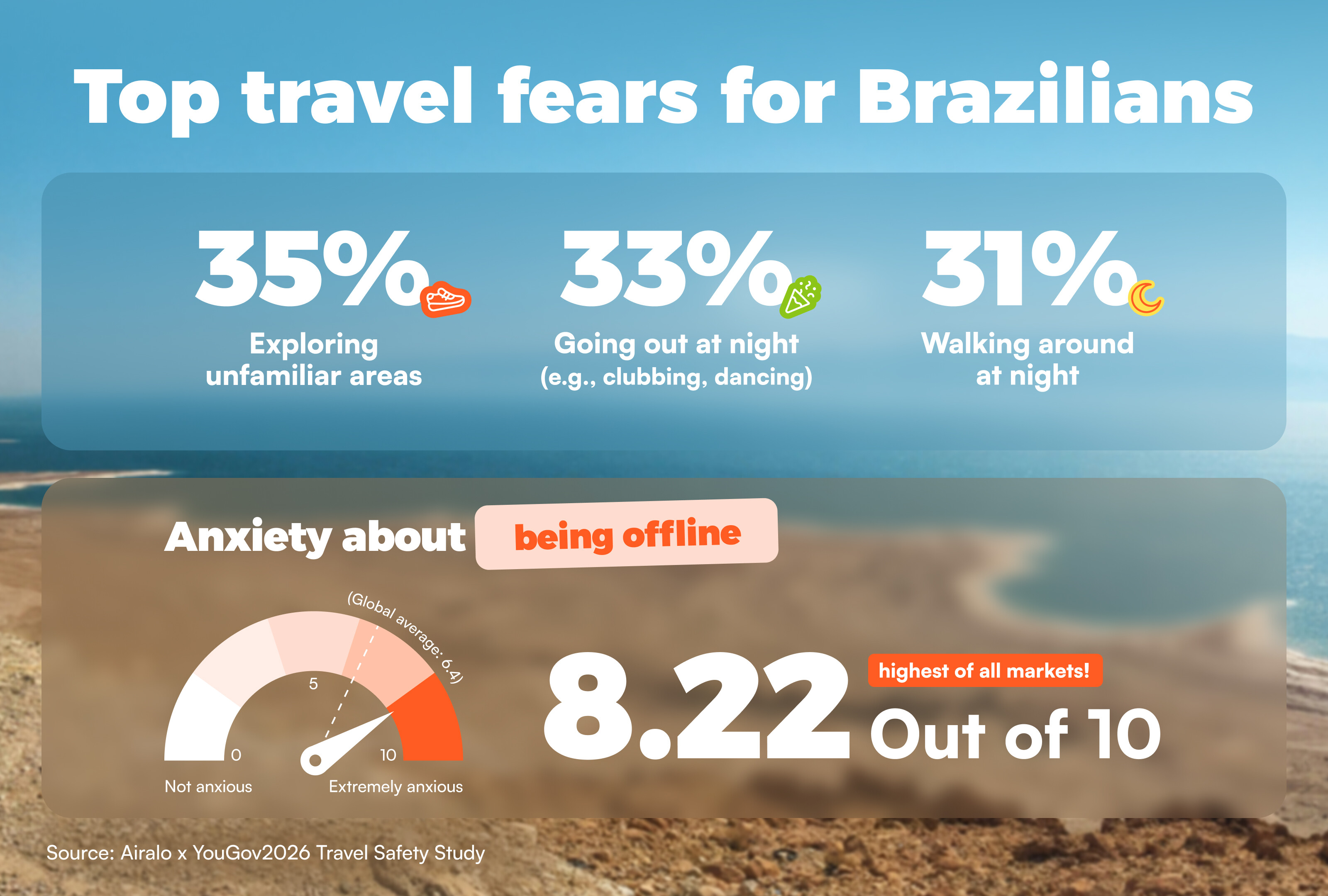 WHAT SETS BRAZIL APART
Because Brazilians rely so heavily on connectivity to feel secure, losing signal is a major disruption. When they go offline abroad, Brazilian travelers report a stress level of 8.22 out of 10. That’s a full point higher than any other market in the study. For this group, a stable data connection isn’t just a nice-to-have convenience; it’s a vital extension of the safety net they already depend on every single day.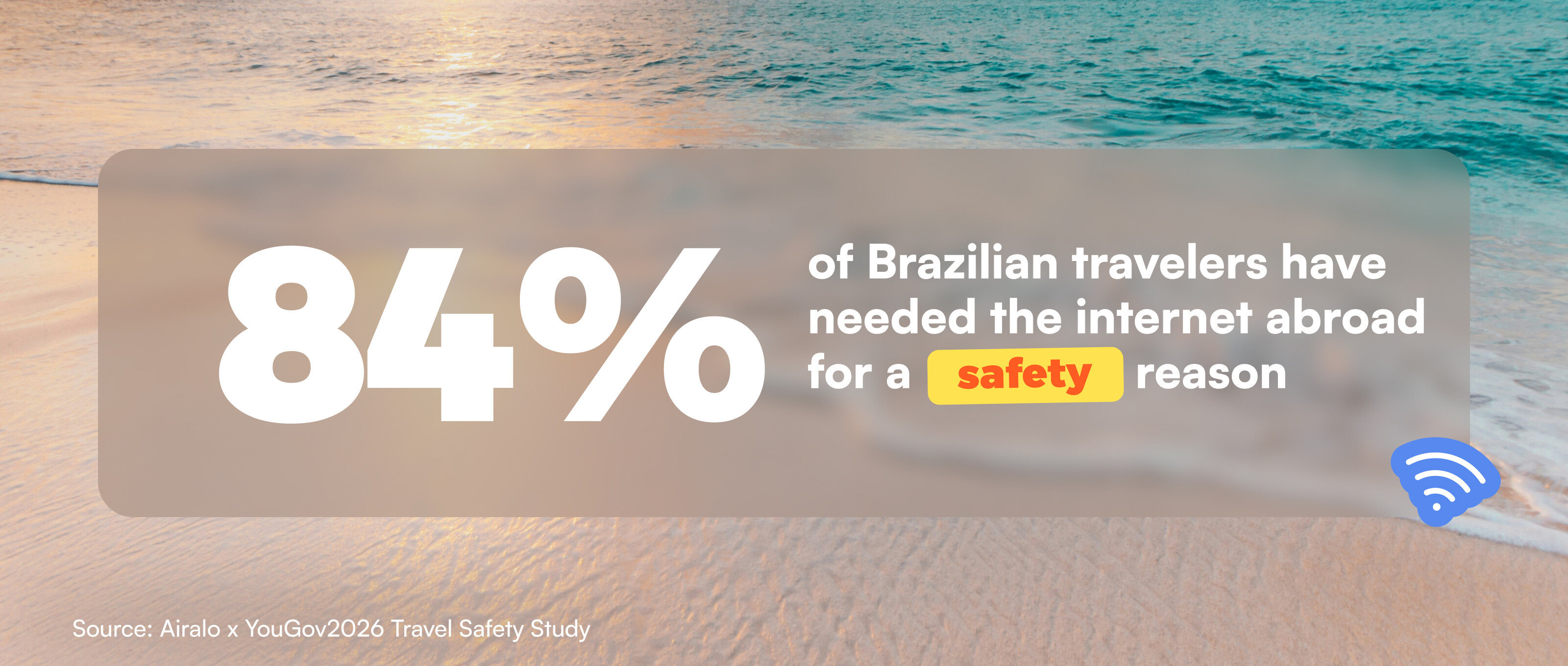
THE BRAZILIAN IDENTITY GAP
While the national baseline for travel concerns is already on the higher side, these numbers climb even further for women and LGBTQIA+ travelers, who navigate trips with unique considerations:
- 68% of Brazilian travelers said that their gender is a personal factor that affects their sense of safety
- 38% of Brazilian women worry about going out at night (compared to 33% overall)
- 40% of Brazilian LGBTQIA+ travelers cite their sexuality as a safety factor (five times the national average of 8%)
- 32% of Brazilian LGBTQIA+ travelers cite their gender as a safety factor (nearly three times the national rate of 12%)
HOW BRAZILIAN TRAVELERS RELY ON CONNECTION
With connectivity acting as such a crucial part of their travel strategy, Brazilians are absolute power users when it comes to mobile data. Here’s how they use their connection to explore confidently:
- 73% rely on maps and travel apps to flawlessly navigate their surroundings
- 60% use translation apps to bridge language gaps and connect with locals
- 55% share their live GPS location with friends or family members to ensure someone always knows where they are
MEXICO
App-savvy travelers focused on communication
For Mexican travelers, the biggest travel worry isn’t actually walking around at night. Instead, exploring unfamiliar areas and communicating with locals take the top spot. This is a significant departure from almost every other country in our study (only Mexico and Brazil rank something other than nighttime safety as their primary concern). Because many international trips for Mexican travelers are quick hops north to the US, heading further afield truly feels like stepping into the unknown. To navigate this, Mexican travelers are incredibly proactive: a leading 64% actively use dedicated travel safety apps, marking the highest usage rate anywhere in the world.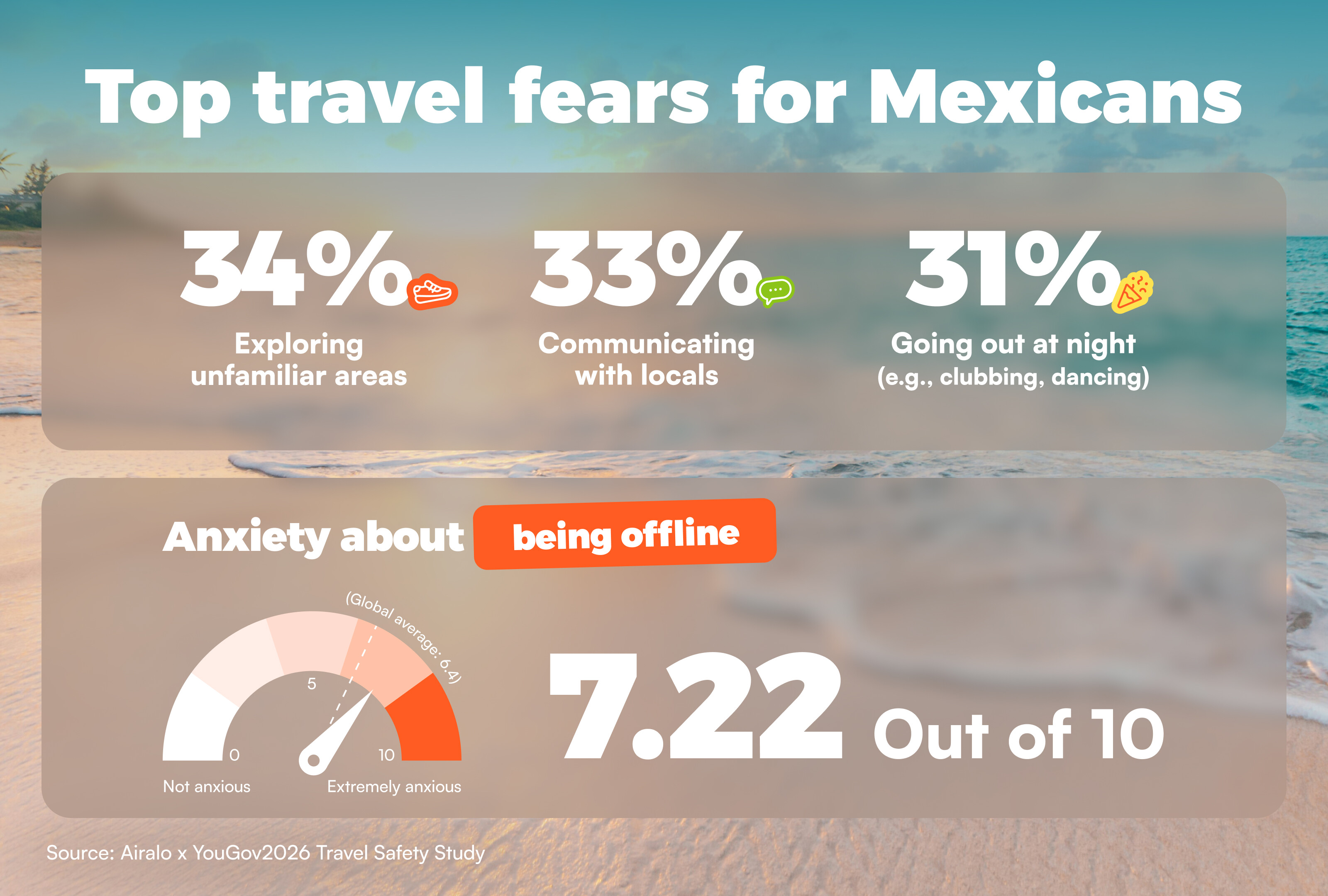 WHAT SETS MEXICO APART
The anxiety around communicating with locals is real: 33% of Mexican travelers cite it as a top concern, tying with the US, Canada, and Australia for the highest rate in the study. While nighttime safety isn’t the top worry nationally (29%), it spikes dramatically for solo travelers. For the 24% of Mexicans who travel alone, concerns about nighttime safety jump sharply to 56%.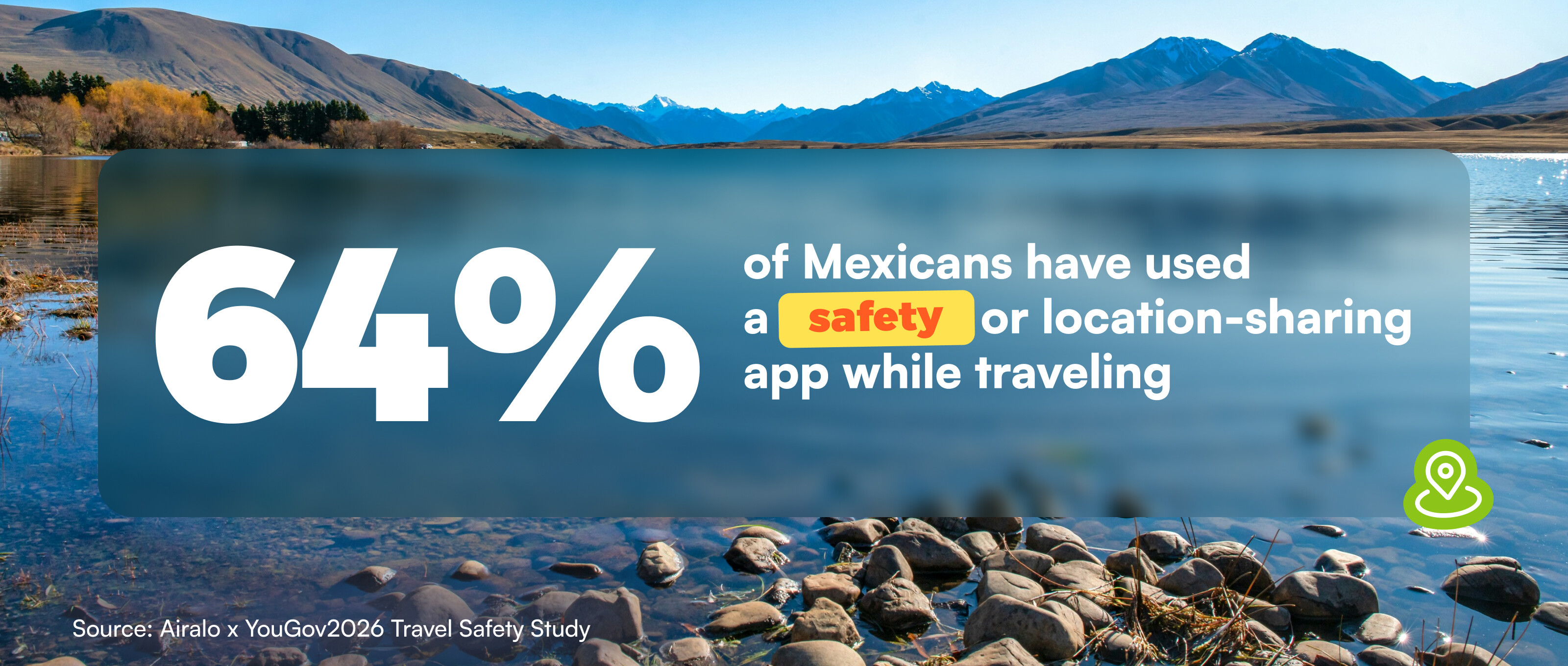 THE MEXICAN IDENTITY GAP
When it comes to personal identity, women and LGBTQIA+ travelers in Mexico report notably higher concerns than the national average, showcasing a need for stronger digital safety nets:
- 12% of Mexican women cite their gender as a personal safety factor (compared to 9% overall)
- 94% of Mexican women say having mobile data is absolutely essential to their safety while traveling (compared to an already high 90% overall)
- 24% of Mexican LGBTQIA+ travelers cite their sexuality as a safety factor (compared to just 4% overall)
- 79% of Mexican LGBTQIA+ travelers are more willing to visit a riskier destination if they’re guaranteed internet access (slightly above the national average of 77%)
HOW MEXICAN TRAVELERS RELY ON CONNECTION
Because they’re so prepared and safety-conscious, reliable data is a non-negotiable part of the journey for Mexican travelers. Here’s how they put their connectivity to work:
- 58% rely on maps and travel apps to confidently explore unfamiliar areas
- 55% update friends or family back home with their current location
- 55% share their real-time GPS location with loved ones for an added layer of security
KEY TAKEAWAYS: HOW TO STAY SAFE WHEN TRAVELING
Staying safe abroad ultimately comes down to a little proactive planning and treating your mobile data like essential travel gear. Taking just a few minutes before your flight to save emergency contacts, plan your evening routes, and secure your digital connection is the easiest, most affordable safety upgrade you can make. To help you navigate unfamiliar places with confidence, we’ve turned these insights into a quick, easy checklist for your next trip.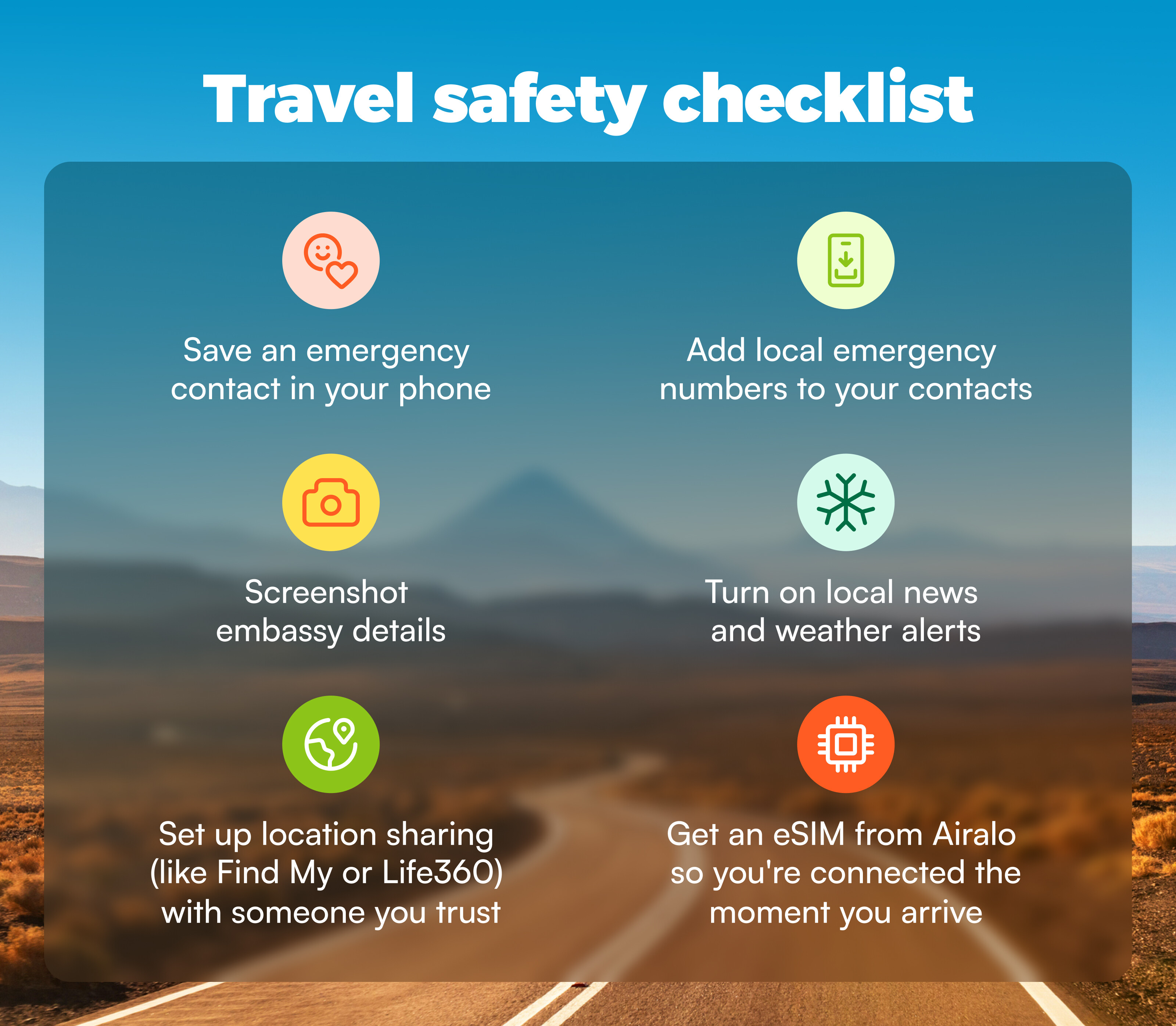
2027 TRAVEL PREDICTIONS
Based on shifting habits, here’s what we expect to shape the travel landscape in 2027:
- Solo travel will keep booming: Traveling alone remains the biggest personal safety factor globally (28%). However, 83% globally say a reliable connection directly eases those worries — meaning connectivity is making solo travel far more accessible and less intimidating. Expect travel brands to build tools specifically for these explorers rather than treating them as an afterthought.
- "Off-grid but online" becomes the standard: A sweeping 77% of global travelers say stable internet gives them the freedom to explore further off the tourist trail. Travelers still want remote, hidden gems — they just want the comfort of a strong signal while exploring them.
- Connectivity as a planning criterion: Data coverage is joining weather and costs on pre-trip checklists. Reliability is the absolute top priority (54%), edging out easy contact, widespread coverage, and transparent pricing (all tied at 51%). Speed sits lower on the list; travelers just want a connection that works when they need it.
- Inclusive safety tools take center stage: Women and LGBTQIA+ travelers report the highest safety concerns and the highest adoption of safety tools. This is a massive market signal, and 2027 will bring a new wave of products explicitly designed around these unique needs.
- eSIM adoption hits a turning point: Global eSIM adoption upon arrival sits at 18%. Meanwhile, 28% of travelers still overpay for home SIMs, and 18% scramble for airport Wi-Fi. The value of an eSIM is crystal clear in the data — now it’s just about getting the word out.
- "Riskier" destinations get a second look: Guaranteed internet makes travelers significantly more willing to visit places they might otherwise skip. While data doesn't magically change a destination's physical safety, it completely transforms how confident and prepared travelers feel.
About This Study
Airalo’s Global Travel Safety study was commissioned by Airalo and conducted by YouGov among 4,527 international travelers across nine markets: the United States (502), Germany (503), Canada (500), the United Kingdom (501), Italy (504), France (509), Australia (502), Brazil (502) and Mexico (504). All respondents had traveled abroad within the past two years. Samples were made representative by gender, age and region within each market. Fieldwork dates were July 7-16, 2026 for the United States and Germany, and Aug. 5-24, 2026 for Canada, the United Kingdom, Italy, France, Australia, Brazil and Mexico.
About Airalo
Founded in 2019, Airalo is the world's leading travel eSIM platform, trusted by more than 30 million travelers across 200+ destinations. We don't just connect people to mobile networks, but to the places, people, and moments that make travel worthwhile. We build the technology that removes the last remaining friction from global movement, so travelers can arrive anywhere and belong instantly. Our fully remote team of 400+ people lives by the same borderless philosophy we build into our product.
For media inquiries, please contact
[email protected]

